How we live, how we eat, how we move.
Food, housing, infrastructure and mobility account for 72% of all natural resource use in Aotearoa New Zealand. So we started where New Zealanders recognise themselves first, in everyday life.
Circularity already exists here. It is unevenly supported, and disconnected.
Māori enterprises are here, practising closed-loop food and fibre grounded in values that predate the language of circularity by centuries. The regenerative producers are here. The researchers are here. The businesses are here: Forest Lodge runs a fossil-fuel-free orchard at commercial scale, Ecogas operates the country’s first commercial-scale anaerobic digestion facility, Phoenix Recycling recovers solar panels and batteries.
The challenge is that whilst each industry or sector may have its own map, mandate and logic, the full value potential of circularity sits in the spaces in between.
LIVE
What comes into a home, what happens while it is there, and what is left when we stop using it, redesigned not through individual sacrifice, but through better infrastructure, smarter systems and clearer rules.
Industries
Construction and building, infrastructure and utilities, packaging and FMCG, textiles and clothing, household goods and appliances, electronics, retail, waste and recycling services, repair trades.
Materials
Building materials (timber, steel, concrete, plastic), packaging, textiles and fibres, e-waste and electronics, household and consumer goods.
Focus areas
Local resource resilience · repair, reuse and sharing networks · design for durability and disassembly · digital material passports · waste and pollution reduction · place-based community systems.
The bin is not the system. It is the last two metres of it.
By the time something arrives at the kerb, every decision that matters has already been made somewhere else, in a factory overseas, in a design meeting, in a building consent, in a procurement contract signed a decade earlier. The household is handed the object and the obligation at the same moment.
Households pay for products designed for replacement, and then they pay again to dispose of them, and the second payment is treated as a council service rather than a design consequence.
of resources used per person each year, the equivalent of ten passenger cars.
of our resource consumption comes from recycled materials.
of everything disposed at levied landfill in 2023 was construction and demolition waste.
of soil goes to landfill every year, the one material we cannot manufacture.
For every tonne of plastic we recover, close to six tonnes go into the ground.
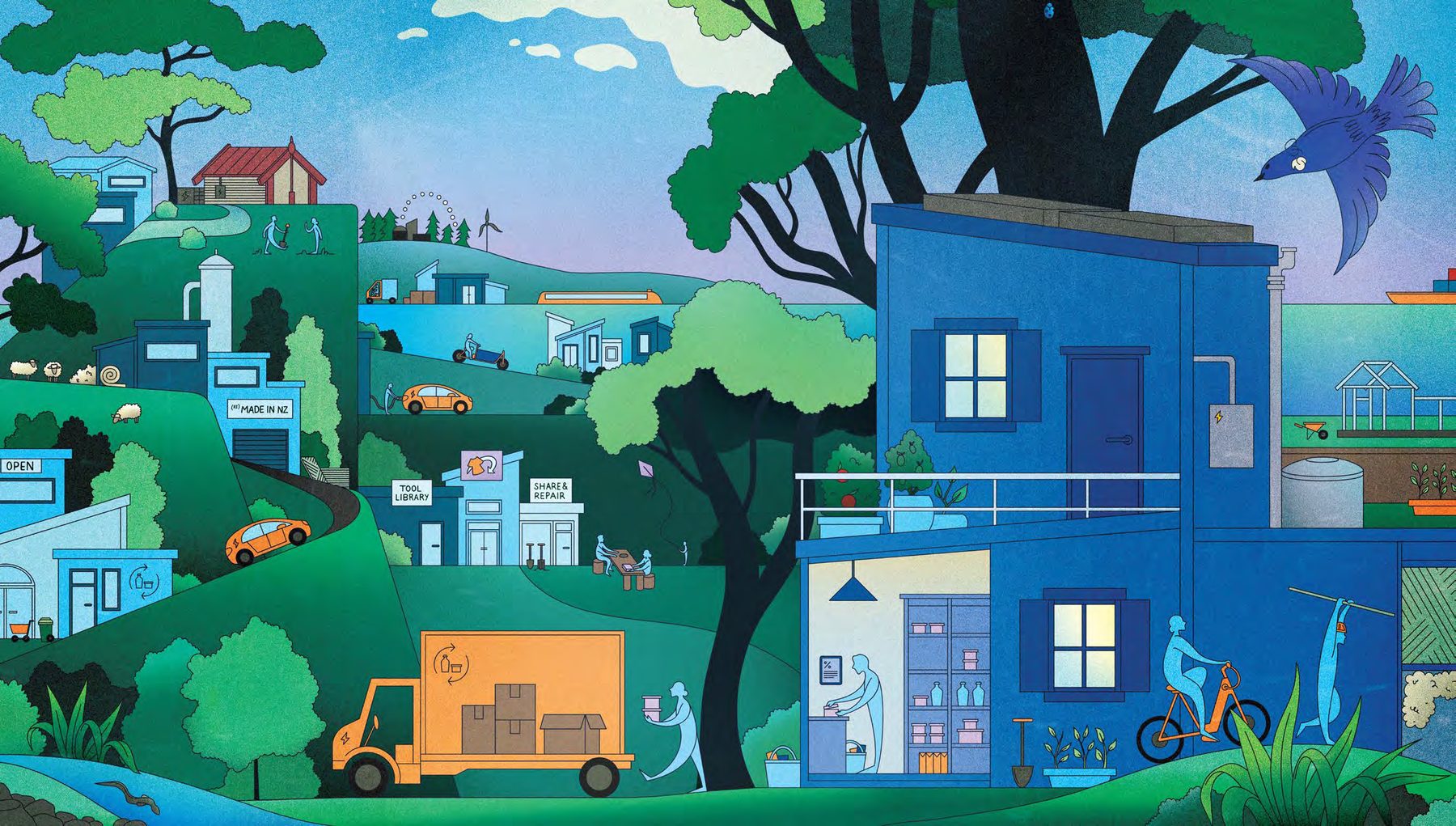
A house is a place where materials rest in our care for a while.
The shelves hold staples in containers built for return, not lighter or smarter packaging, but containers owned by the system rather than by the household. The empties go back as unremarkably as the recycling routine, travelling a few kilometres to a wash-and-refill facility that employs people from the suburb it serves.
Step outside and the street does the work the household cannot do alone. The repair café is open more than one Saturday a month, because it has funding, skilled staff and ongoing venue hire. There is a tool library, a toy library, and a clothes swap that runs to a schedule people can plan around.
The house itself was built to be disassembled. A digital product passport records what went into the walls, so the family repairing a kitchen in fifteen years knows what the cabinetry is made of, whether it can be reused, and who will take it. On the roof, solar. In the garage, a battery that spent its first decade in a car and will spend its second here.
What has to change.
New Zealanders cannot solve this by making better choices alone. The willingness exists. What is missing is the enabling system.
- Buildings designed to be unmade: modular construction, adaptive design, material passports and deconstruction planning written into consenting and procurement.
- Bio-based materials become everyday materials: wool, harakeke, hemp, timber and forestry residues, with the processing, testing and recovery pathways that keep the value here.
- Nature as infrastructure, not amenity: funded for flood resilience, food security and ecological health rather than for how it looks.
- Repair as the affordable first option: right-to-repair rules, affordable premises, parts obligations and skills training. Repair and reuse generate eight times more jobs per tonne than recycling.
- Reuse infrastructure that works: standardised returnable containers, local wash-and-refill capacity, and reuse built into workplace and school procurement. New Zealanders saved an estimated $844 million through reuse in 2025.
- Textile flows managed as a system: design standards, import requirements and extended producer responsibility, with eco-modulation that shifts responsibility upstream.
- Safe chemistry to enable recoverability: because harmful content does not close one circular pathway, it closes repair, resale, remanufacture and recovery at the same time.
EAT
The flow of nutrients from the soil and waters of place to the nutrition on our plates, and back again. Replacing short-term extractive productivity with long-term resilience.
Industries
Agricultural, horticultural and crop production, renewable energy, food manufacturing and processing, functional foods and nutraceuticals, retail and grocery, food distribution, education and rescue.
Materials
Soil and nutrients, organic waste and by-products, fertiliser inputs, food product design and processed food, bioactive compounds and energy.
Focus areas
Regenerative practices and soil health · bioeconomy · regional and shared processing · by-product valorisation · nutrient cycling · food waste and redistribution · procurement reform · diverse crops and land use.
Homogeneous landscapes are harming our health and creating vulnerability.
Drive through the New Zealand landscape and it looks natural. But these landscapes don’t reflect the true potential of our diversity; they reflect what was left over. Land too steep, too cold, too wet or too remote to farm became conservation land. Almost everything else became monoculture.
Conversion of our land has come with a disposition of diversity in both our landscapes and our culture. We are rapidly depleting the natural resources, in particular the soil and water, we depend on to grow our food, and generations of tangata whenua grow up in a landscape their tūpuna could interpret, and they cannot.
We traded the ‘infrastructure of the middle’ (the aggregation, storage, transformation and distribution that connects growers to eaters) for cheaper imports and streamlined corporate balance sheets. Between 2002 and 2022, our vegetable growers reduced from 2,820 to 900.
Our food is increasingly processed and unhealthy for us. The places we have left to connect with food are rarely places of joy or connection.
These are the failures of the linear food system. They have been designed in. They can, and should be, designed out.
of the food needed to feed our own population is imported.
of our land is in cropping and horticulture, every vegetable, orchard, vineyard and grain paddock.
of topsoil washes into our waterways each year.
worth of food is wasted in New Zealand households annually.
One in three New Zealand households have experienced some form of food insecurity in the last year. Only 8.2% of our children meet the recommended daily vegetable intake.
When nutrients flow, nutrition follows.
Food is not a commodity. Food is aroha.
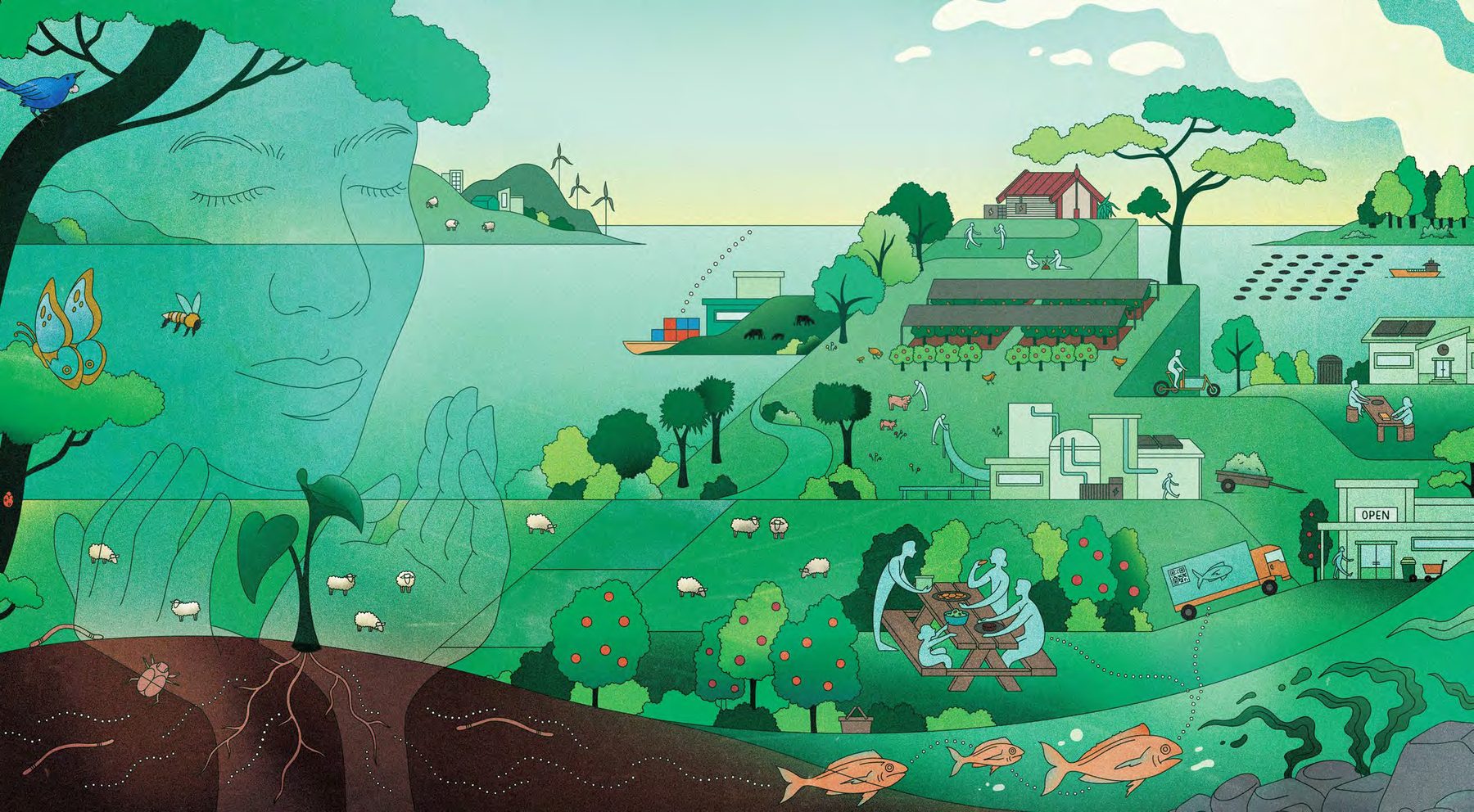
A food system built from love is one that values nutrition through the cycling of nutrients. That system starts at the soil, fed by a diversity of plants, organic materials, bacteria, fungus and insects. Soil that looks like it smells good.
Farms, orchards and production systems are visibly diverse, with trees for honey, fibre and shelter growing within and between arable, horticulture and agricultural land. Apple orchards have solar panels over the rows. Sheep graze alongside wheat, oat and quinoa in rotation. Anaerobic digesters sit beside dairy sheds, converting excess food into energy for milking and biofertiliser for pasture.
A school kitchen in Waikato lists buckwheat and vegetable fritters, kūmara wedges, mussel chowder, every ingredient sourced within 80 kilometres. That single contract change meant fifty farmers in the surrounding district shifted a portion of their land to diverse cropping, because for the first time there was a guaranteed buyer.
What has to change.
We don’t lack the ingredients of a circular food system: the species, the skills and the facilities are already here. We lack the ability to see them and the means to combine them.
- Local nutrient recovery and cycling: regional composting, anaerobic digestion, constructed wetlands and biochar returning water and nutrients to living soil.
- On-farm energy generation: mid-scale solar across our ~50,000 farms could generate 28–33,000 GWh a year, equal to 63–75% of current national electricity consumption.
- Diversified crops with regional processing: soy, hemp, chickpeas, oats, buckwheat and quinoa, backed by the modular 'infrastructure of the middle'.
- By-product valorisation: every residue becomes an ingredient: whey into lactoferrin, peas fractionated into protein, starch and fibre, kelp into biostimulants.
- Procurement as the major lever: government agencies spend $51.5 billion a year on goods and services; school, hospital and council contracts can anchor demand for nutrition and provenance.
- Food produced everywhere, by everyone: in our streets, parks and backyards, by citizens, communities, councils and producers.
- Te Tiriti honoured in shaping the food system: with Hua Parakore and Kai Motuhake as foundations for food sovereignty and soil health.
MOVE
How citizens move, how goods arrive and return, and what our vehicles and infrastructure are made of. Transport conversations here focus on emissions; this widens the lens to materials, lifecycles and total cost.
Industries
Public transport and fleet operators, freight and logistics, automotive, energy and electricity, infrastructure and construction, shared and micro-mobility, EV and battery manufacturing.
Materials
Vehicles and vehicle parts, batteries and critical minerals, road materials (asphalt, steel), charging infrastructure, renewable energy infrastructure.
Focus areas
Lifecycle materials recovery · second-life battery deployment · shared mobility and micro-hubs · decentralised energy · lifecycle cost disclosure in procurement · materials registers for public assets.
We are planning the energy transition without planning the materials.
There is a car parked outside your house right now. It sits idle over 90% of the time, and around these low-productivity assets we have built a material-intensive roading network, a fuel import chain, a parking economy and a tax base.
It is also a material store. An average vehicle entering New Zealand in 2020 will not be scrapped until around 2040, and every decision about what happens to the material inside it was made at the point of purchase, twenty years before anyone needs to act on it.
-
01
The first is that electrifying the fleet is materially intensive, not materially neutral.
-
02
The second is the car outside your window, still parked.
of total emissions come from transport, our largest source of long-lived greenhouse gases.
of transport emissions could be cut by 2035 using technology that already exists.
of cars in Aotearoa are electric. We need to be over 35% by 2035.
of demand for materials like cobalt, graphite and lithium could be met by recycled supply by 2050.
Mobility is not just an asset you own. It’s the freedom to move.
A vision for how we move: mobility that is renewable and circular by design.
A transport system designed for flow lets people and goods move freely through a network. Its assets are made, used, and remade as demand shifts towards abundant clean energy.
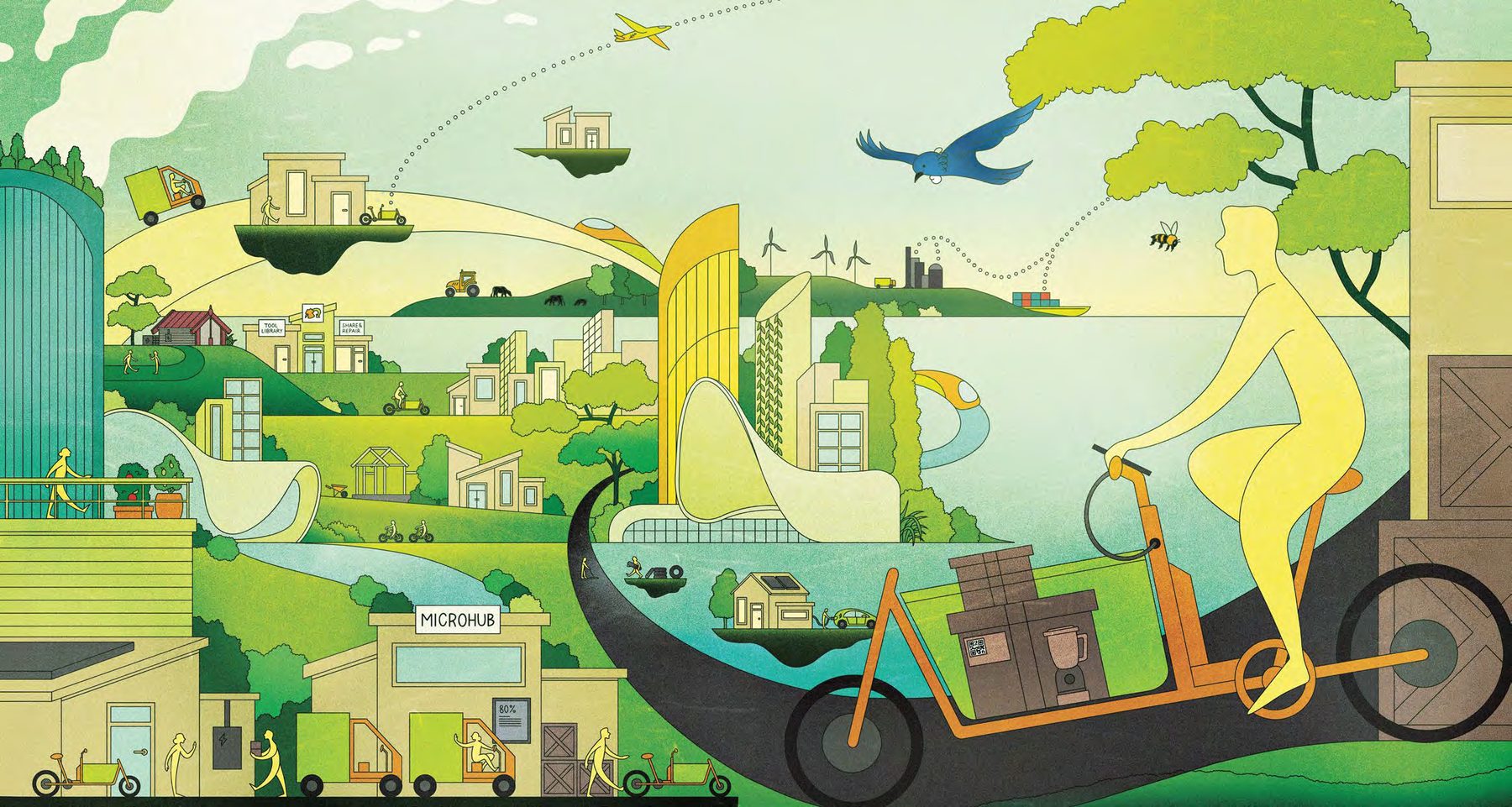
Picture a delivery arriving to a suburb in Wellington. It did not come in a van making 40 individual drops. It came by cargo bike, ridden by a local worker from a micro-hub in the old goods yard, where a larger truck consolidated loads before handing them to a fleet of bikes for the last mile. The cyclist makes 15 drops in the time a van makes four.
On the rider’s phone, an app shows the bike battery’s digital passport, its chemistry, how many charge cycles remain, and what it is cleared to do next. When it is too worn for delivery runs, the app identifies its next job: a storage unit behind the local library, holding daytime solar so the evening reading programme runs on power that never touched the grid at peak.
The street itself was repaved using recycled rubber from end-of-life tyres blended into the asphalt binder, alongside materials recovered from a demolished overpass rather than freshly quarried aggregate. The old asphalt keeps its mauri rather than being discarded for something new, extracted, and empty of history.
What has to change.
What is missing is not new technology. It is coordination, procurement reform, and deliberate market development, connecting what already works, here and elsewhere, into a system.
- Fewer, fully used assets: compact mixed-use cities, local goods consolidation and shared mobility. In Wellington, each shared car already replaces eleven private ones.
- The energy stack, not fuel substitution: human power first, then electric assisted, then shared electric, battery-electric freight, hydrogen only for the narrowest segment, and biomass-derived fuels reserved for marine and aviation.
- Electrification with full lifecycle planning: right-sized batteries specified through procurement, matched to real duty cycles rather than maximum range.
- The battery’s second decade: an electric bus battery in the Netherlands does not retire when the bus does; it is pulled, tested and redeployed into local energy storage for another decade.
- Materials registers and passports: tracking a battery, a garment or an appliance across its whole life, not just its first sale. The EU mandates a digital battery passport from 2027.
- The micro-hub model for last-mile logistics: in London, 39 car park spaces became a last-mile hub that removes up to 85 vans a day and around 23,000 vehicle journeys a year.
- Infrastructure as a materials bank: roads, buildings and stations designed to be recovered from and adapted, and to regenerate the living systems they run through.
When energy and water flow, everything connects.
One imagined place (a street, a farm, a marae, a town) where the circular systems run through the same ground, the same water, the same currents.
Forest slash that would once have been burned off becomes biochar, feeding soil and producing energy as it is made. Food waste collected from processing sites becomes biogas, heating the modular hubs that turn diverse crops into diverse food, its digestate returning to the land next door as fertiliser. Batteries store and share power for homes during a blackout before becoming off-grid storage for farms, marae and community halls.
What moves between the home, the farm, the marae, the repair hub and the city moves both ways: what is taken out is matched by what comes back. That reverse loop is what makes this a system rather than a supply chain.
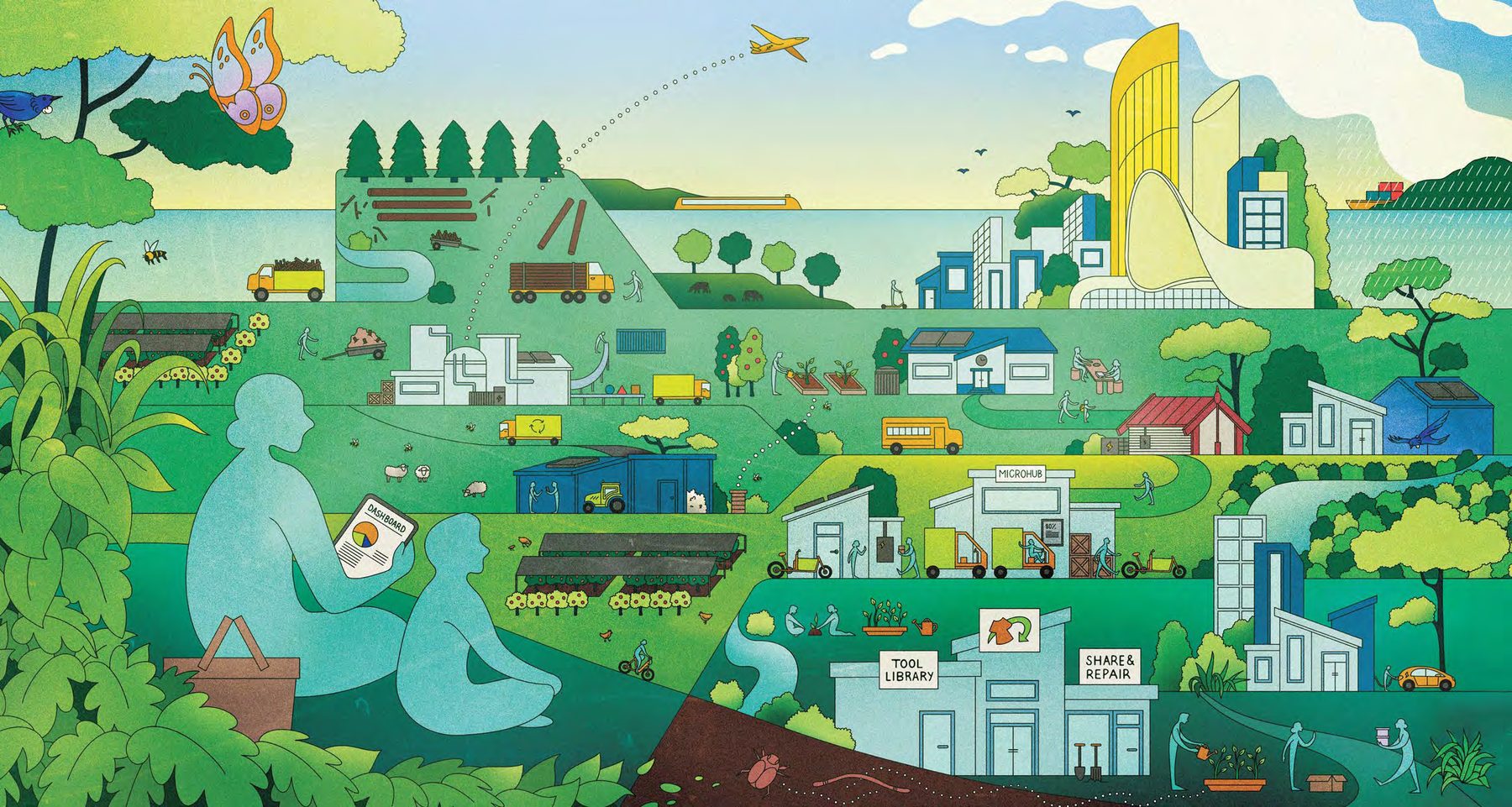
This is one region, one version of the future, drawn from research that already exists, from businesses, communities, marae and citizens already building parts of it across Aotearoa today. It is not the finished picture. It is what became possible when we let ourselves imagine these systems connected, rather than apart.

Turning this into Aotearoa New Zealand’s future.
That depends on what comes next: three recommendations, and on the people, businesses, communities and government who choose to build a circular future with us.